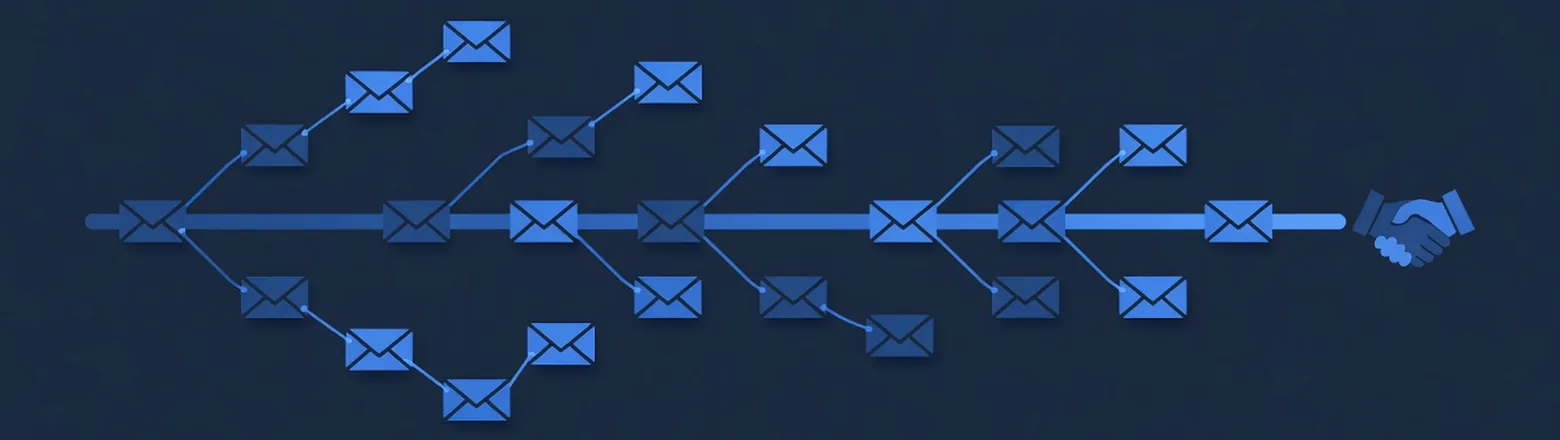
For law firms, email marketing often means newsletters no one reads. Firms buying leads need a narrower, more profitable use: automated sequences that keep the firm visible during a 6-12 month decision cycle, so a prospect who was not ready in February hires in September.
We covered the strategy in nurturing long-cycle leads. This page is about the tooling: what to run the sequences on, compared for a firm with 5-10+ attorneys.
Three options
CRM-native sequences: the best default for most firms
If the firm runs intake software like Lawmatics or Law Ruler, sequence automation is already in the subscription: triggered emails and texts, case-type branching, pipeline-stage conditions, all operating on the same record your intake team works.
Using one database matters more than any single feature. When the follow-up tool and intake process share that database, a prospect who replies or books mid-sequence exits automatically, sequences branch on intake data (case type, language, stage), and nobody maintains a sync between two systems that disagree about who exists.
The limit is email capability. Template editors, deliverability tooling, and reporting run shallower than dedicated platforms. Most firms hit that ceiling later than they expect, and many never do.
ActiveCampaign: automation depth per dollar
ActiveCampaign offers the strongest mainstream automation value: deep branching logic, tagging, lead scoring, and solid deliverability at mid-market pricing.
It earns its integration overhead when follow-up needs outgrow the CRM-native ceiling: multi-language tracks, content-driven sequences per visa category, or scoring that decides which prospects intake re-calls. The firm must maintain the connection between its CRM and ActiveCampaign. Without an owner, that connection fails over time.
HubSpot: the platform decision
HubSpot's marketing tooling is excellent, and buying it for email alone is overpaying. Its automation, CMS, forms, reporting, and attribution come as an integrated platform, priced accordingly.
HubSpot makes sense at this size when the firm commits to content marketing (SEO plus follow-up plus attribution in one place), wants marketing reporting the managing partner reads, and has someone who owns the system. Absent that commitment, ActiveCampaign does the sequence work for a fraction of the cost.
A word on Mailchimp
Mailchimp works for newsletters. Legal follow-up requires triggered, branching sequences for each prospect based on CRM status. Firms that start here because it is familiar typically rebuild on CRM-native, ActiveCampaign, or HubSpot within a year. Skip the intermediate step.
Side by side
| CRM-native | ActiveCampaign | HubSpot | |
|---|---|---|---|
| Integration work | None | Sync to own | Sync or platform migration |
| Automation depth | Moderate | Deep | Deep |
| Texting in same tool | Often yes | Add-on | Add-on |
| Content/CMS tooling | No | Light | Strong |
| Reporting | Intake-centric | Campaign-centric | Full-funnel |
| Cost shape | Included | Mid-market | Platform pricing |
| Fails when | Follow-up outgrows it | Nobody owns the sync | Nobody owns the platform |
What the sequences should actually say
Whichever tool you choose, follow three content rules:
Segment by case type. A family-petition prospect and an EB-5 investor share nothing about timeline, anxiety, or reading interest. Generic firm newsletters teach prospects to ignore you; case-type sequences teach them you understand their situation. This is where purchased leads have an advantage: they arrive with the segmentation done. An Immileads lead lands in your CRM carrying visa type and screening answers, so the right sequence fires from message one.
Use email for the later months, not the first days. The first days belong to phone follow-up, not email. Sequences provide the most value during the long middle: process explainers, document checklists, honest timelines, what-changes-when content that keeps the firm useful while the prospect's life catches up to their case.
Review every message for compliance. CAN-SPAM basics (identity, unsubscribe, address) are the minimum. Your state bar's attorney advertising rules also apply. Have templates reviewed once, then reuse the approved structure.
The sequence still needs a steady flow of prospects.
What to read next:
- How leads reach your CRM shows how visa-type data starts the right sequence immediately.
- Speed to lead for law firms explains why phone calls take priority in the first days.
- Nurturing the 6-12 month lead covers the long decision period email is best suited to.
FAQ
When are CRM-native sequences enough?
When is ActiveCampaign worth the sync?
When is HubSpot worth its higher overhead?
What belongs in the first long-cycle sequence?
What should automatically stop the sequence?
Ready to grow your immigration practice?
Qualified, exclusive immigration leads: fixed price per lead, no retainers, no long-term contracts. Start with a 30-100 lead test batch.
GET STARTED